
Bonjour, Trieste
A city that's unplaceable — in a good way.

After spending a few days in and around Chioggia, places in the Venetian lagoon that are almost nothing like Venice (Chioggia is sometimes called “Little Venice,” but it’s not, not by a long shot), I met Kathleen in Trieste. I’d been here just about 20 years ago, en route to meeting Lidia Bastianich in Istria, where her family’s roots are. (An amazing trip, which I wrote about here.)
Toya Boudy is this week’s guest on Food with Mark Bittman. Listen here!
I remember Trieste for its sweeping, grand piazzas and classic city-on-the-bay look, but also its seeming non-Italian-ness. This isn’t surprising: although it’s been part of Italy for most of the last 100 years (it was ruled by the Nazis for a little while and was a “Free Territory” for a few years after the war), Trieste was part of the Austrian empire for most of the last few centuries. Everyone speaks Italian (at least publicly), and much of the food feels “Italian,” but the look is so formal and Central European that it’s hard to get a handle. It feels … unplaceable. But in a good way.
Of course this is a little silly, like saying that Charleston (or New York, for that matter), doesn’t feel like “America,” because you’re used to Des Moines or Los Angeles. Every country of any size is heterogeneous not only in its population but in its ways of speaking and its local appearances.
I came to Trieste in 2007 to write about the food, though everyone here talks about coffee. Trieste is the home of Illy, but really, so what? I’ve had badly made Illy coffee and so have you, and most brand names are no guarantee of quality. But aside from that, the coffee-roasting and -making skills here are world-class, and a simple coffee — an espresso — can be something to truly savor.
The meat culture, however, is one of the things that makes Trieste seems so weirdly non-Italian. There’s a kind of bollito misto (“mixed boil”), served in steam table type restaurants that remind me so much of New York’s old Kosher delis that my mouth starts watering at the thought. Of course they’re far from Kosher — they’re centered on pork — but the trimmings are mustard, sauerkraut, pickles, even horseradish, all of which I grew up with. The classic place is Buffet da Pepi, which will serve you a dozen (or more) cuts of pork, from ear (decidedly awesome) to fresh ham, all served with mustard and horseradish. This is all “normal” and very Triestian. (And written about everywhere, ad infinitum.)


(Sadly, we didn’t have Jota, which is a very good soup found in Slovenia, throughout Friuli, in extreme northeastern Italy, and especially in the area around Trieste. Sort of like a soupy cassoulet. Recipe below.)
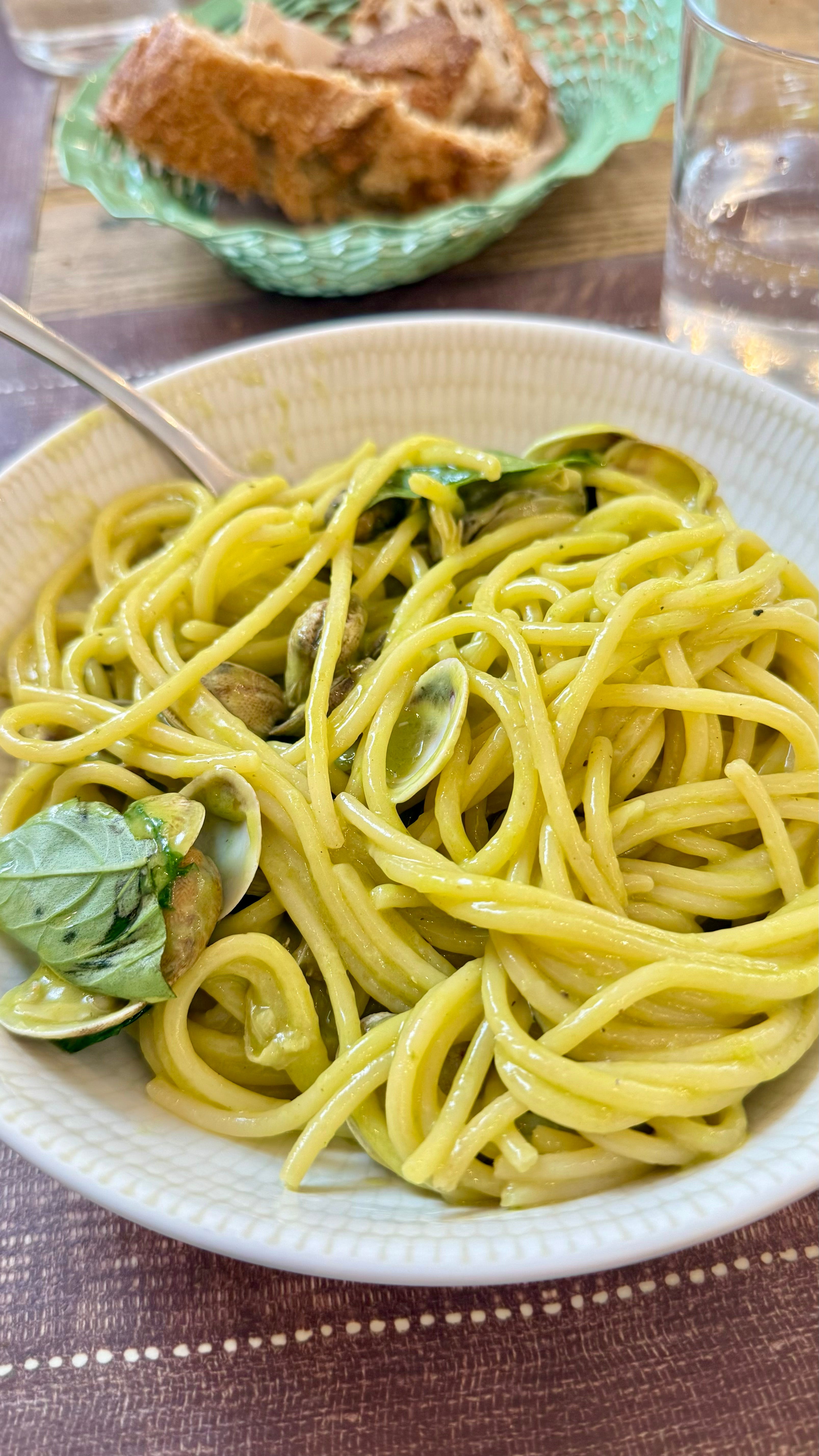
Anyway: We were lucky enough to be steered to a little place called Mimi & Cocette (by this excellent Guardian piece), which looks (I’m sorry to say) like an organic vegetarian restaurant from 1995, but features the day’s vegetables, cooked as you might, a few pasta dishes (many fresh; a woman rolled pasta in a corner through one of our meals there), a little meat and seafood.
